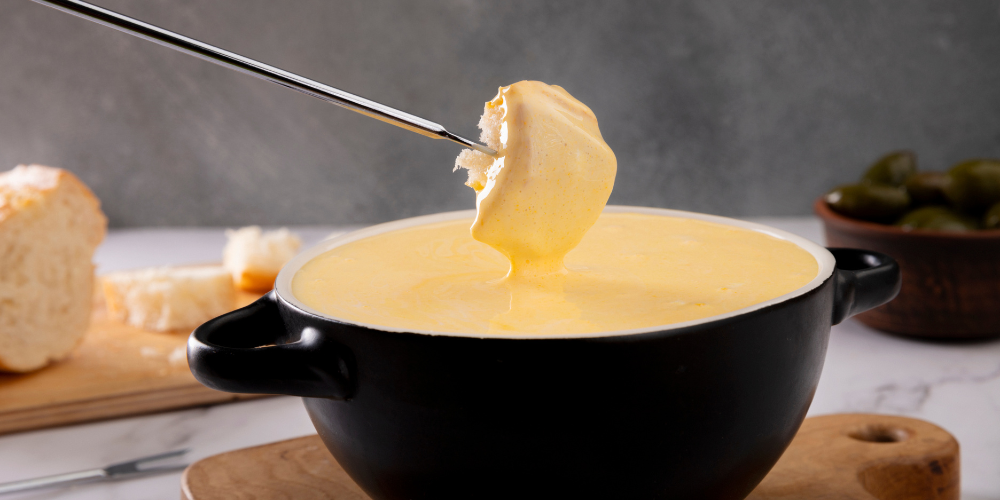
Fondue seems simple—melt cheese, add wine, dip bread. Yet the difference between a decent pot and one that turns silky, savory, and balanced comes down to cheese choice and technique. Chefs and cheesemongers agree that when fondue tastes just right—smooth, elastic, and layered with flavor—it almost always starts with two classic Swiss cheeses.
This guide breaks down the exact cheeses professionals rely on, the ratios they prefer, the science behind Alpine meltability, and the common mistakes that ruin texture.
The Gold Standard
Ask experts what belongs in a traditional fondue pot and the same answer appears again and again: Gruyère and Emmentaler.
Together, they form the backbone of authentic Swiss fondue. Emmentaler ensures a smooth, dependable melt and stable texture, while Gruyère contributes rich savory notes and a distinct nutty character that gives the blend depth and balance.
Zach Berg, cheesemonger at Mongers’ Provisions, keeps it traditional. “When I’m making a classic cheese fondue, I go for the classics. I want Emmental and Gruyère — or if you enjoy something bolder, grab an Appenzeller.”
Casie Wiginton, cheese specialist at Antonelli’s Cheese, does not waver. “Always, always, I reach for Emmental and Gruyère. It is the original recipe — a 50/50 split — and for a dish that loves to fall apart on you in the blink of an eye, it’s sometimes best to stick with the tried and true.”
That 50/50 blend is widely regarded as the original formula. It offers balance and stability in a dish that can easily be separated.
Why These Cheeses Melt So Well
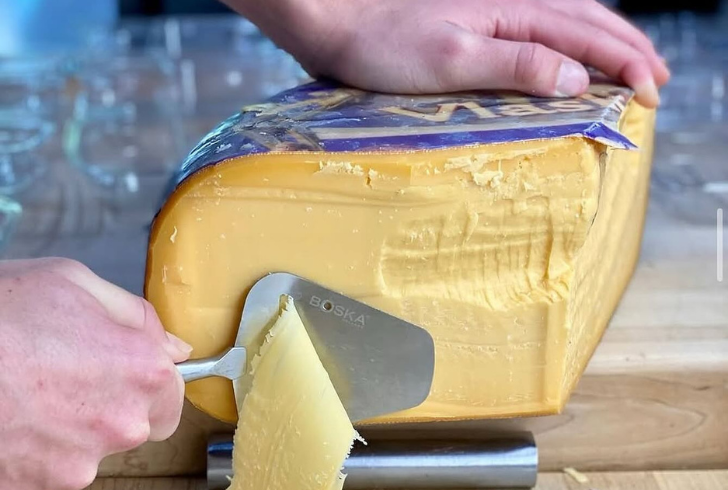
Instagram | beemstercheese | Achieve the perfect fondue by blending savory Gruyère with smooth-melting Emmentaler.
The answer is chemistry. Alpine cheeses such as Gruyère and Emmentaler are cooked and pressed during production.
Jeff O’Neill, executive chef of The Hirsch at Goldener Hirsch, explains:
“The curds are heated a second time so they all melt back together. That creates a smooth, uniform texture and the ability for the cheese to melt beautifully once it’s fully set. Pressed cheeses like cheddar lack that step, which is why they tend to separate.”
Alpine cheeses work so well in fondue because they have moderate acidity, a flexible yet stable protein structure, balanced fat content, and a strong casein network.
When gently heated with wine and stirred properly, the proteins unwind gradually. As a result, the cheese forms a creamy emulsion instead of breaking into clumps and oil.
In contrast, cheeses like Parmigiano-Reggiano, aged Gouda, or sharp cheddar often separate because they lack the same structural design.
Getting the Ratio Right
Cheese selection matters, but proportions shape flavor and texture.
Gillian Nyswonger, who cooked in Swiss kitchens and prepared fondue to order at London’s Swiss Centre, followed a strict formula.
“A 60/40 ratio of Gruyère to Emmental was strictly implemented for a nutty flavor, creamy texture, and ease of melting,” she says.
Food writer Lynda Balslev, who lived in Switzerland for a decade, prefers a slightly different structure:
“Two parts Gruyère Surchoix to one part another Alpine cheese — Swiss Emmentaler or aged Comté. I avoid mild and go for nuance.”
While 50/50 remains traditional, many chefs adjust:
– 50/50 for balance and authenticity
– 60/40 Gruyère-heavy for deeper flavor
– 2:1 Gruyère blend for added intensity
Zach Berg suggests thinking in roles instead of strict math. Choose one cheese for fat and texture—Emmentaler, Raclette, or young Gouda—and another for flavor, such as Gruyère, Appenzeller, or Challerhocker. Because both cheeses melt well, the ratio can shift based on taste preference.
Common Mistakes That Ruin Texture
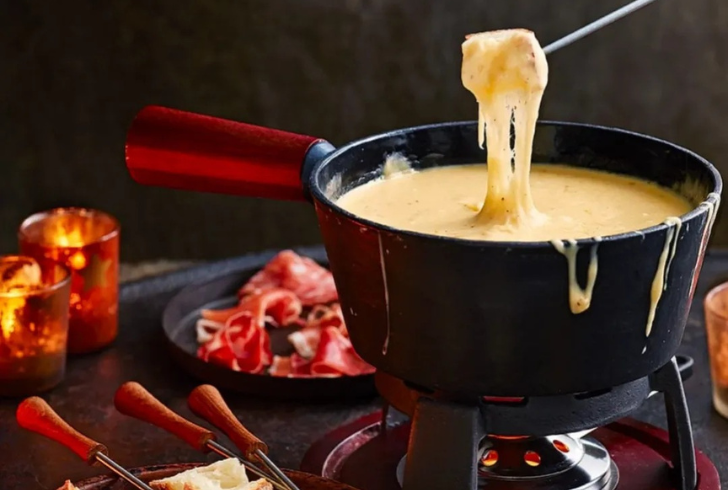
Instagram | @thecornercounter | Modern fondue twists succeed only when chefs respect melting science while blending cheeses like Vacherin and Gruyère for smooth texture and bold flavor.
Fondue fails when heat and timing go wrong. Nearly every expert warns against rushing.
Casie Wiginton explains, “Fondue is essentially an emulsion. You have to add the cheese gradually, stir slowly, and not shock the temperature.”
Overheating causes proteins to tighten and squeeze out fat. Vigorous stirring makes it worse. The result becomes grainy or greasy.
Zach Berg reinforces the point: “Go slow and low. If it’s way too hot right away, the proteins become bouncy and seize up, and you’ll never get the smoothness you’re looking for.”
Lynda Balslev adds a final rule: “Stir constantly and never let the fondue boil.”
Modern Twists That Respect Tradition
Creative variations work best when they follow Alpine melting principles.
Zach Berg favors a Swiss moitié-moitié blend of Vacherin Fribourgeois and Gruyère. Lynda Balslev suggests incorporating softer cheeses like Reblochon for added richness. She also recommends removing the rind from Harbison, made by Jasper Hill Farm, before adding it to the pot.
Casie Wiginton points to Challerhocker for bold flavor or Fontina Val d’Aosta for an Italian-inspired version.
Mandala sometimes enters the conversation as well. The Brazilian cheese carries the complexity associated with Gruyère while melting in a way that recalls Emmentaler. Swap nutmeg for cumin and serve the pot with pão de queijo and slices of picanha, and the dish becomes an international spin that still honors fondue’s basic structure.
Experimentation aside, technique does most of the heavy lifting. Cheeses must melt evenly, the heat should stay controlled, and each addition needs time to blend properly so the emulsion stays smooth.
Gillian Nyswonger offers a practical reminder: “Sometimes it’s good to stay with authenticity. Why fix something when it’s not broken?” Time and again, the familiar combination of Gruyère and Emmentaler proves why it became the standard in the first place.